Wednesday, May 30, 2018

Green Smoothie (recipe)


Since my last post was all about eating your vegetables, what better way to celebrate than with a green smoothie?  Green smoothies are a great way to get some serious raw veggies in your diet, and it's easier on your digestive system than straight up raw veg.  You're kind of 'hacking the digestion' as a friend of mine described it.

peaches & blueberries


All you need is fruits, vegetables, water and a blender.

I like to use some frozen fruits, as I enjoy my smoothies year-round, and fresh peaches are hard to come by in February.  There's pretty much no wrong way to make a green smoothie, but this is my favorite super-simple combo:

Some frozen peaches and blueberries (About 1-2 cups total.  Peaches are my favorite base--sweet, but not as cloying as bananas.)


GREENS--I like baby spinach, kale, and swiss chard.  Sometimes in a pinch I'll use frozen kale and spinach, but the fresh baby stuff blends up real smooth.  I put in about 3 cups, give or take.


For me, the most vital ingredient is 1/4 of an avocado.  It gives the whole thing a little bit of slip and creaminess (you can also use some kind of milk, like coconut milk, but nothing beats the avocado for my taste.

The majestic avocado

Add about 2 cups of water, and blend!
ready for action!

Cheers!


Tuesday, May 15, 2018

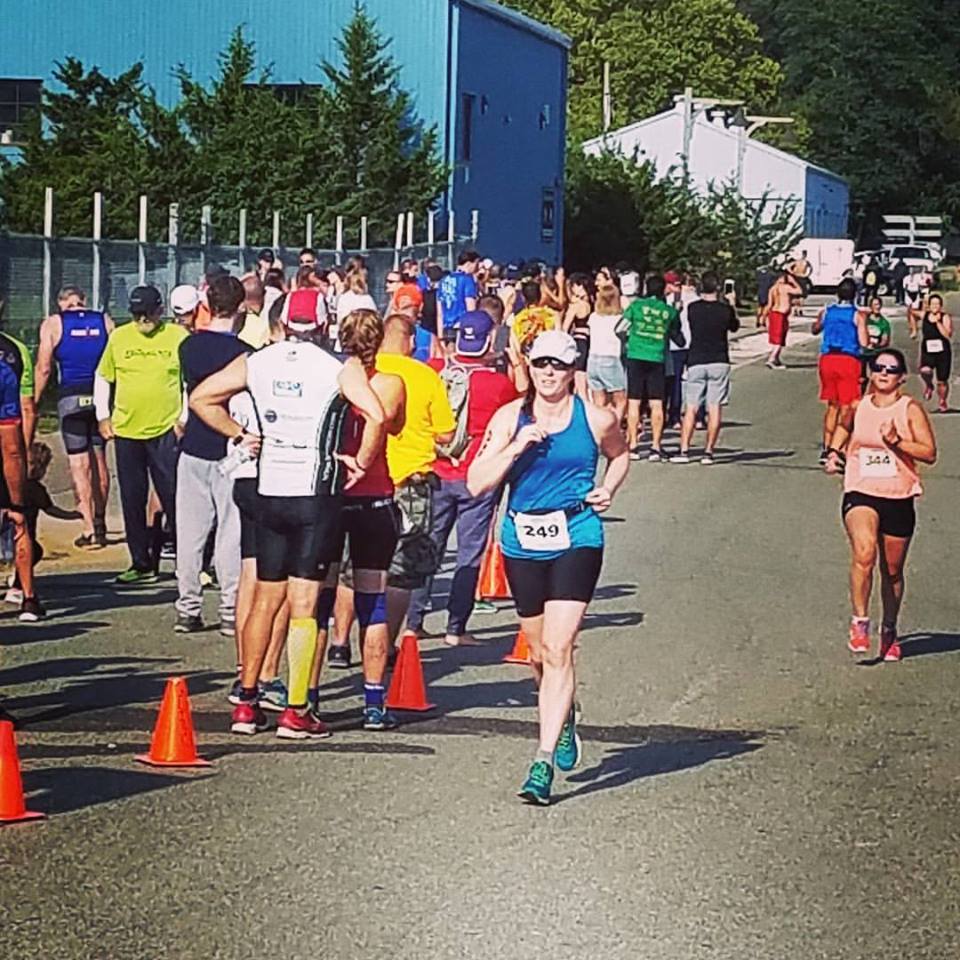
26.2

Yep, it’s another post about running.  Full disclosure, the last one was just a primer for this one.  But it’s also about a cause, so please bear with me.

Last spring, when I was getting ready to complete my first open-water sprint triathlon, my only running distance goal was 5 kilometers, as the race ended in a 5K.  I remember telling my husband (who is a long-distance runner from his high school days), “I think a 5K is as far as I ever want to run.” 
And so, in May, we joined some friends at the Long Island Color Vibe 5K and jogged it together, playing in powdered paint, taking silly selfies, and sampling the frozen ice truck’s wares.

That day, when I got to the end of the run, I turned to the aforementioned husband and said “maybe a 10K. I feel like I could run that again.” (I think you see where we’re going here.)

So when my CrossFit coach urged the members of our gym to sign up for a local 10K, I saw my chance to give it a stab, and I started going longer distances on my training runs.

Up until this point, I wasn’t really ‘enjoying’ running, but I was determined to do it, because it was part of triathlon and some doctor once told me I shouldn’t (and therefore, I believed, I couldn’t) do it, and nothing makes me want to do something more than an ‘authority figure’ telling me not to. 

When I surpassed the 5-mile mark, I finally felt that thing that runners keep talking about feeling (and that for years I believed didn’t really exist), that zone of calm euphoria that comes from placing one foot in front of the other over and over and over again. 

I still love climbing and surfing and skiing and hiking, but there’s something about just strapping on your shoes and hitting the road all by yourself for an hour (or two or three) that is so accessibly blissful…it’s the ‘runner’s high’ and it’s real.  I remember the first time I felt it, and I thought to myself, “I’m gonna run a marathon!”  (pause) “Next year!”  (pause)  “Maybe!”

So, I did a 10K in September of 2017.  And then there was the half marathon in November (because doubling distances was now becoming a pattern).  Adam and I decided that this occasion was momentous enough to warrant a fundraiser, and in a pretty short time, we were able to raise about $600 for Disabled American Veterans in honor of our favorite Vietnam Vet, Mike Baritot.  

When I completed the Queens Half, I knew for sure I wanted to do a marathon the following year—it’s my white whale, the thing that PT told me I would need to do ‘a LOT of strength training’ to be able to accomplish.


When I didn’t get picked for the NYC Marathon lotto, I started thinking of alternatives (including looking at different marathons around the tri-state area)—a friend assured me that he could get me in to the NYC Marathon through some connections, and I considered this option, though I felt a little uncomfortable ‘sneaking’ my way in.  I also considered running for a charity team, though I was daunted by the amount of dollars I would be required to raise.

And then.  And then.  A really close friend and colleague of my husband, a vibrant and lovely young woman in her 30s, so full of life it’s almost hard to feel anything other than comatose by comparison, was diagnosed with breast cancer.   She’s been writing her own blog, chronicling her journey here:  https://sheisfiercecancerblog.wordpress.com/

She’s not the first friend or family member of mine to battle this ugly disease, but she is one of the youngest, and she had already lost her mother at a young age to the same disease. 
so much money to raise.

The announcement of her diagnosis was the moment when I knew what I wanted to do.  I wanted to run the NYC marathon and raise money for breast cancer research and screening. 

So nauseous.  So cramped.
I’m still daunted by the amount of dollars I need to raise, as I am daunted by the number of  miles I need to run, as I am daunted by the pressure I have put on my self by making this goal so public.I wake at night in terror from the decisions I have made.  I think of the hyponatremia I gave myself during the last race (by drinking too much water and not taking enough sodium) and the barfing I did after that race, and I wonder if I’ll be able to calibrate properly for double the distance.  

I think of my history of back problems and the recurring sciatica that troubles my right leg.   I think of my tendency toward patellar tendonitis, and my difficulties nourishing myself properly with food allergies.  I worry that the autoimmunity will get in the way; I’ll get too tired, or fall sick.  I think maybe I’ve made a horrible mistake.  There’s no way I can do this.

And then I think of her.  And I think of the others.  I think of the terror they face when they get called into the office after a routine mammogram.  I think of the shudder down the spine upon hearing the word ‘malignant’.  I think of the dread they feel when they prepare for the surgery to remove what they hope is all of the cancer.  I think of the daunting task of going to chemo “therapy” (torture, more like) every other week, of the weight and hair lost.  I think of the barfing and nutritional challenges, the physical pain and all the awful side effects that come from ridding one’s body of a deadly disease by using an ostensibly non-deadly poison.

I have a choice.  I could back out, give up, decide it’s not worth the trouble.  They cannot.  They have been handed their lot, and must suffer the consequences of cruel happenstance, and they must battle, or lose.

And so I have chosen to run. 

During every training run, I will think of them.  Every time I feel weak and tired, when my hamstrings are screaming and my organs are protesting, I will remember that I am making a choice to run, and my ability to do so is nothing short of a divine gift, one that not everybody has the luxury of experiencing. 

For too long, my friends and family have been hijacked by their bodies and drafted into a personal war against cancer against their wills.

This November, my husband and I are running the New York City Marathon with Team Think Pink Rocks to raise a combined total of $6,000 to fund Breast Cancer research and screening. 

Please consider helping with our cause—A little gift can go a very long way to helping all of us get a little closer to a cure.  To donate, simply click the link below:


Thursday, May 3, 2018

"It's Because You Ran"


I’m not a runner.  I’ve never been a runner.  As a kid, I was the one who got picked last for every game in gym class (not only am I slow, but I’m the pits at throwing, catching, dribbling, kicking…basically I’m not good at sportsball).  I was the last one walking the final lap on the track during the mile run.  In high school and college, I did a little jogging for fitness, but when my knees started complaining (apparently, I’ve got a thing called ‘chrondomalacia of the patella’, which is fancy talk for ‘irritable kneecaps’) I decided that running was for chumps.

So I stuck with my bicycle.  I kept fit doing all the things that people who hate running do to keep fit.  And I was in better shape than your average couch potato, so that was good enough for me.

And then there was the herniated disc flare-up.  When I went to my chiropractor, his first question was “did you run?”  Me?  Run?  I thought back to the days leading up to this unspeakable pain, and I did recall how I was late for a rehearsal, so I ran a few blocks to make up time getting to the theatre.

“It’s because you ran,” he told me.  That’s what caused this pain.  It’s because I ran.  A few blocks of hustle to the theatre and now I can’t walk or sit or stand or sleep.  Because I ran.

For years, I believed him.  After my surgery, both my GP and my surgeon urged me to get moving as soon as possible, and to make fitness a priority in my life.  They cautioned me against any heavy weight lifting, at least for a while.  I was encouraged to do low-impact activities, like swimming and yoga.

So for a few years, I added new and fun ways to stay fit.  I started with climbing (slow, fun, natural traction).  


I swam, rode my bike (as long as you stay hunched over and loose, it’s pretty chill on the spine), tried aerial silks, and started hiking.  


As I got stronger and more confident, I added more adventurous activities, namely skiing and surfing.


When I visited my surgeon years later for a consultation to see if pregnancy would be dangerous to my back health (before we knew how messed up my fertility situation was) he asked me what kind of activities I was doing.  His eyes grew wide and he asked “do you ever fall down while doing these adventure sports?”


“All the time.”  I replied.  When he asked if it hurt to fall, I said “only the normal amount.”  He shrugged and said to me:  “Go on.  Do whatever you want.  No limits.” 

No limits.

Well, that’s intimidating.

We didn’t get pregnant anyway, so when a friend asked me if I might want to join him in a sprint triathlon, I decided that my old chiropractor was full of baloney and I was going to run, darn it.

I got myself a pair of $35 dollar running shoes and started running, working my way up to a 5k. 

Except that after a month, my knee started to hurt.  I kept running (it’ll get better on its own!).  The knee got worse.  I kept running.  The limping started to cause more problems—my other knee started to hurt, and now my back was throbbing.

I withdrew from the race and sought medical attention.  The Physical Therapist I worked with did a great job helping me recover—she mentioned that my quads were highly developed from cycling, but the rest of my leg muscles were less so, creating an imbalance which exacerbated my pre-existing knee issues, which then led to the back pain.

I asked her point-blank “is my body just not made for running?  Is this a dream I need to give up?”  She sighed and said “you can—you just need to address this muscle imbalance and be careful.”


“So, could I ever, say, run a marathon?” 

“Well,” she said, “you would need to do a LOT of strength training.”

Once I was established in Strong Island, I found the nearest CrossFit Location to my home—CrossFit 516 in Williston Park, Long Island. 

I am aware of how polarizing and controversial CrossFit is—I had read every horror story about injuries and rhabdo and the like, but I also know that there are horror stories about pretty much every activity (including and especially inactivity) and I decided I wanted to give it a try.  I was ready to lift big weights and get strong so that I could maybe ever run one day.

I’m not going to launch into a massive love letter to CF516, but let’s just say that joining this gym is pretty much one of the greatest life decisions I’ve ever made.

The cruel irony of the timing is that I joined right as the gym was starting a sprint cycle.  This is to say, the whole gym was pretty much just running.  No kettlebells, no weights, no bear crawls—running. 

Not only was I slow, I was terrified.  Even though this is exactly the sport I was determined to conquer, it was the one I was most afraid of, and I wasn’t expecting to get right into it right away. 

I dissolved into tears on the walk back from a ‘sprint,’ and my coach pulled me aside. I told him about the herniated disc, the surgery, the pain, the fear, and that one time a doctor told me that my pain was “because you ran”. 

He hugged me (sweatily) and said “thank you for telling me.”  He then told me that he also has herniated discs. This is a guy who ran a 100 mile race last April.

I’ve only cried twice at CrossFit, and both times it was because of the kindness I was shown by the coaches. Kindness always gets me in the feels.


Soon enough, we moved on to a new cycle, and I was swinging kettlebells and picking up weights and putting them down. 

Then one day, the workout on the board was “run a 5K”.  There was a hand-drawn map on the board of a 5K loop around the neighborhood.

I was for sure the last person in the gym to finish, but I ran every single step.  That was my first time ever running 3.1 miles nonstop, no walking.  That’s when I knew I could run.  I could really run now (albeit slowly).


So here I am (with my husband) at the ColorVibe 5K.


And here I am finishing the Panatella Sprint Triathlon 5K.


And here I am finishing the Tobay Sprint Triathlon 5K.


And here I am at the Cow Harbor 10K.


And here I am at the Queens Half Marathon.


See that big, dumb smile on my face?


It’s because I ran.


image sources:
http://jakelikesonions.com/post/166538472359/maybe-hes-running-from-the-truth
http://www.uopc.org/sports-medicine/chondromalacia-patellae/
http://crossfit516.com/

Monday, April 23, 2018

My Big Fat Uterine Fibroid(s)


In my mid-thirties, I was very intent on becoming a pregnant person.  A lot has happened in the five years since I wrote that blog post, but one thing has not changed:  I am not a mother, and the likelihood that I will become one grows smaller every year.

But that's not what this post is about.  This post is about the sharp pain I felt during that period of my life, the one in my lower abdomen.  At first it was just an isolated jab.  Then it happened again.  And again.  And again.

So I went to my gynecologist, who ordered a sonogram, which revealed a small uterine fibroid (about the size of a walnut).

If you're unfamiliar with what this is, it's a benign tumor that grows inside or alongside a person's uterine wall.  They are surprisingly common (something like 30% of uterus-bearers have them at some point in their lives), and yet "the exact cause of uterine fibroids is unclear" (to quote Wikipedia).

Really? That's where the medical community has decided to leave off on this topic? Ladies, maybe try not having a uterus so much, and then this won't happen to you!

If you dig a little deeper than Wikipedia, there are some theories floating around about the growing number of people dealing with fibroids--and other internal medical problems, many affecting reproductive organs--which claim that, like the allergy situation, civilized life might be slowly killing us from the inside. Constant contact with plastics and pharmaceuticals are be taking their toll on our bodies (even if you don't take any medications, our water supply is riddled with chemical compounds from pharmaceuticals--we're all doomed). But these conjectures are all theoretical and definitely not of any interest to most Western medical doctors. After all, if we were to all get well and stop needing medicine, how would anyone get their kickbacks?  But I digress. We were talking about my tumor.)

"It's not serious and it shouldn't affect your fertility in any way," I was told.

Okay, sure.  I believed him.

So I went on about my life, changing towns, changing jobs, and quietly accepting my fate as a childless woman (adoption is an option best saved for people with better finances than mine, and my triumphant return to classroom teaching did little to foster my interest in having children in my home anyhow).

The pain got a little worse.  So we re-scanned the uterus.  My fibroid had grown larger, and had gained a little friend. Big Betty was now the size of an apricot, and her cohort was about the size of a cherry. A uterine fruit salad, if you will.

"It's not serious and it shouldn't affect your fertility in any way."

So I went about my life and joined a CrossFit Gym (more on that later) and got into the best shape of my life (thus far).

But the pain got worse. Much, much worse. By 2016, my lower back began to revolt, making driving or sitting of any kind nearly impossible. I stood through staff meetings and professional development sessions. Invitations to a movie or concert were torture (sit? for TWO HOURS??).  I had to empty my bladder every 30 minutes (which is about how long I could sleep at a stretch) and I had menstrual cramps for three weeks out of every month.

We re-scanned the uterus.  Little Cherry was still a tiny tot, but Big Betty had now grown to 9 centimeters in diameter (just shy of a softball). Add in the fact that I apparently have a 'tilted uterus', and we have the explanation for my back pain (though my new gyno did not think one had to do with the other whatsoever--spoiler alert--I was right).

not my fibroid, but not unlike my fibroid.
My doctor's best recommendation was an open abdominal myomectomy. This is a surgical procedure where the uterus is removed entirely, the tumors are excised from the organ, and then the uterus is replaced. It's like having a cesarian section, but instead of birthing a baby, you birth a mass of squishy flesh. Once, my bikini waxer even mistook my incision for a c-section scar and asked me: "when did you have the baby?" (Don't assume that every horizontal abdominal scar is the result of motherhood.) I still tipped her. But only 15%.


I was quick to agree to the surgery. Like the herniated disc, the pain had become so intense and constant that I could no longer carry on.  I was taking enough Advil to elevate my blood liver counts. Once, when a co-worker said to me: "you look like you're in pain" I simply responded: "All. The. Time." and walked away. Not for the first time, I wondered why a human so genetically predisposed to unwitting self-destruction (me) had been allowed to survive into adulthood.

"Cut it out of me and kill it with fire" I told my doctor.  I knew the risks, including the possibility that the myomectomy might become a hysterectomy, but the surgery went perfectly, and when I woke up, I was relieved to learn that I still had a uterus.


I had been through a big surgery before.  I had returned to work two weeks later.  I didn't see how this should be any harder than a discectomy.

Boy, was I wrong.  You ever try and re-pack a suitcase after taking everything out?

I think that's what it's like, trying to put your organs back in after taking them out.  Nothing ever fits back in the way it did in the first place. The first day I went back to work after my two weeks of home rest, I had to take another two days off for the massive stomach virus I had managed to contract (nothing like barfing while holding your stitches in place).  Soon after, thanks to the degradation of my abdominal muscles, I was being MRI'd for the new (and yet old) sciatica pain down my right leg (this is what 2 weeks on a couch will get you).  I had another (rather large) lumbar herniated disc. Thank goodness for Pro Sports Physical Therapy in Garden City--I've been symptom-free for over a year since my 6 weeks of therapy with them.

Just like herniated discs, fibroids can crop back up, so that's a possibility (probability, even?) that I live with. For now, though, things are working well.  In spite of my gyno's somewhat aggressive attempts to get me to pursue fertility treatments (full disclosure: I'm shopping for a new doctor), I'm still an apparent barren wasteland down there, but my uterus keeps ticking along on her pointless monthly schedule like always, so at least I'm keeping the menstrual industry in business.

But I never felt quite 'the same' after the surgery, and the last year and a half turned out to be an even more tumultuous time in my personal health and wellness than the years leading up.

But that's a story for another time.  In the meantime, take care of yourself, and try not to get any fibroids.

image sources:
http://www.gynla.com/expertise/uterine-fibroids.php
http://www.fibroid.com/fibroidpictures/
https://www.multitrip.com/blog/art-of-travelling-light-travel-insurance/


Thursday, April 19, 2018

Too Young for Back Problems


My mother has had back problems most of her adult life, stemming from a herniated disc that she was diagnosed with before I was born.  (This is a condition where your discs squish between your vertebrae and shoot tissue all over your very sensitive nerves. It hurts a whole lot).  While she manages to stay as strong as an ox by stubbornly gardening her entire condo complex, she struggles to rise from a seated position or walk on uneven ground. Since my youth, I remember her yelping and reaching around to her lower back every time she stood up.  I prayed I wouldn't ever know the pain she endured.  


(spoiler alert!  I did, soon enough.)


When I was in the third grade, I remember our P.E. teachers giving us our scoliosis test. This involves simply bending over in front of your teacher while someone looks at your back to see if everything looks even on both sides. I remember being asked to repeat the test. I remember them quietly discussing what they saw with each other. I remember them saying "it's fine--it's within the range."  And so I was dismissed, and went back to recess where I excelled at the monkey bars.

At age fourteen, I remember standing up from a seated position, and feeling a pinch in my lower back. I was tempted to yelp and throw my hand to my back, but I did not want to betray my feelings (more on this later).  I turned to my mother and casually mentioned, "my back hurts."  

"You're too young to have back problems!" she exclaimed. There it was. My spine's curvature was 'within range' and I was too young to have back problems. So I didn't.


Except that I did. But since I had already been versed in keeping my feelings to myself (expressing emotions wasn't really a 'thing' in my young life--"crying will only give you a headache" was our mantra), I pretended that my back didn't hurt. I pretended for a pretty long time.

And it didn't hurt *all* the time. But it did hurt sometimes. And then it hurt some more. And then it hurt some more.


In my late twenties, I started to experience a symptom called 'sciatica' (also known as 'radicular pain', or 'ridiculous pain' as I like to call it).  The pain in my lower back was constant, and now I was feeling a shooting pain down the side of my leg, right where the stripe on a pair of tuxedo pants is located (some people experience the pain down the back or front of their leg, but it's the same symptom, related to a different part of the spine). 

I finally decided that maybe I should put my health insurance to work and see a medical professional about this ongoing discomfort.

I went to a chiropractor. He told me that I likely had a herniated disc. I held back my tears (crying will only give you a headache) and continued to seek treatment with him for several months as I lived with the chronic pain.

And then one day it got worse. So, so much worse. One day, I woke up unable to walk. The nerve impingement was so intense, my leg crumpled regularly under my weight. I could stagger around the one-bedroom apartment with the help of walls and furniture. I missed two weeks of work.  While trying to boil tea, I knocked the kettle of scalding water down with me because I couldn't stand long enough to pour it into my cup. I could barely sleep, as the pain woke me every hour. One night, when I could no longer stem the flow of tears or hold back the screams in my sleep, my husband insisted that we go to the E.R.

"We think you have a herniated disc" they told me.

Well, DUH.

They referred me to a neurosurgeon and gave me Aleve and a Lidocaine shot.  I was in excruciating pain (neither of these drug treatments had any effect) and I was horrified that my next step was to visit a surgeon.

I had reached a point of no return. I could not live with this pain. I reached out to my GP.  He referred me to a pain management specialist, who gave me a Cortisone shot. This bought me about six months of function, during which time I sought treatment through acupuncture, chiropractic care, physical therapy, and psychotherapy (did you know that holding your feelings in can exacerbate physical ailments? Maybe crying can actually cure a headache).

But the pain started to creep back, because a Cortisone shot is a temporary measure. Shortly after my thirtieth birthday (and shortly after an MRI revealed not only the suspected herniated disc between two of my lumbar vertebrae, but also a mild case of scoliosis--woops!), I visited three different neurosurgeons who all gave me three different recommendations: the first insisted that I absolutely needed surgery, the second stated that I might be totally fine without it, and the third said it was entirely up to me--only I knew if I was in enough pain to play my 'Ace Card'.

I did play my Ace card, with that third surgeon. He performed a laminectomy and discectomy. When I woke up from surgery, I was already in less pain than I was when I had been living with the herniated disc. I begged the nurses to stop giving me Percoset (the hallucinations I had on that stuff were nothing short of terrifying--it was election season and I had been singing a lot of sacred music--John Kerry and Sarah Palin in Flagrante Delicto set to church hymns were enough to keep me off opiates for good).

Long story short (too late), I had a herniated disc for no apparent reason at a rather young age, possibly due (at least in part) to mild scoliosis, genetics, and/or luck. The good news is that since the surgery, I have been able to regain all of my prior athletic prowess and more. The crummy news is that I'm currently living with at least one more herniated disc, and that this would be far from the last of my health woes before age 40 (and who knows what lies beyond! Life is nothing if not interesting).

This coming September will mark the 10-year anniversary of that surgery. Maybe it'll be time to re-ink old Herman, my butterfly guardian angel who watches over the little scar on my lower back.

To this day, I have not experienced a pain as debilitating or demoralizing as what I went through during the worst of the nerve impingement.

I highly recommend not herniating a disc.


image sources:
https://patch.com/new-york/longbeach/bp--back-pain-its-probably-not-your-herniated-discs
http://www.ivline.org/2010/10/clinical-examination-of-spine.html
http://healthandfoodcorner.com/sciatica-back-pain-take-remedy-youll-never-suffer/


Sunday, April 15, 2018

Asthma & Allergies (& Antibiotics & Autoimmunity)


If you were born in the 20th century, I want you to think back to your elementary school days.  How many of your classmates had seasonal allergies?  How many had food allergies?  How many had asthma?  How many were taking antibiotics on a regular basis?

Probably not a lot.  Back in my day (good god, that's what I sound like now?), we all happily brought our peanut butter and jelly sandwiches to school, full of peanuts and gluten.  I mean, we also nourished our bodies with such healthy options as Kool-aid and Doritos.  The back half of the 20th century (or the '1900s', as the 13-year olds I teach call it) was a weird time, eh?

When I returned to teaching after a nearly decade-long hiatus in 2010, I was astonished to learn how many of our students had food allergies and sensitivities.  At least 25% of the student body needed to take daily medication for allergies and/or asthma.  "Nut-Free" described most school facilities.  Now, in 2018, the student medicine bag I carry on a field trip is packed full of Epi pens and inhalers.  Nearly half of my students have allergies of some kind, and many have asthma as well.


I remember, in 2010, wondering to myself--is this just my imagination?  Was I not paying attention before, or are there more kids with allergies than there used to be?

It was *not* just my imagination.  There have been a lot of theories about the rise of allergies and asthma, and the theory that seems to be gaining the most popularity in published studies suggests that we've let our civilized lifestyle get too clean.

Firstly, let's start by defining an allergy.  Basically, it's your immune system freaking out, thinking you've been poisoned.  By that definition, allergies are essentially an autoimmune condition, which is why allergies and autoimmunity tend to go hand in hand.  The 'we got too clean' theory basically states that, when a child's immune system is in development, it needs to be challenged in order to develop properly. When babies stick things in their mouths, they are heeding nature's call to expose their systems to small amounts of germs and dirt so that their immune systems grow up big and strong. When we take these things out of their mouths and clean them with Lysol and Clorox, we keep the germs away, which means their immune systems aren't getting the practice they need to grow up.

Multiply this over a few generations, and you get a burgeoning allergy / asthma epidemic.


So even though my parents were hardly clean freaks, and they did a really solid job of making sure I was an outdoorsy kid (12 years of camping with the girl scouts--I can make you a seriously gorgeous fire), the sum of the cultural norm of de-germifying all of civilization was greater than their individual efforts.
I was one of the outliers in my cohort (though I would fit right in with my current middle schoolers) who had chronic seasonal and environmental allergies. Bronchitis was my unwelcome houseguest no less than twice a year, and I would take antibiotics every time it hit. I had an inhaler (plus a dispensing chamber which looks suspiciously like an Austin Powers prop) and I consumed enough Robitussin and Sudafed to make a meth cooker blush.   

Around age 12, the rashes on my face, combined with my chronic stomach aches brought me to an allergist who diagnosed me with a casein allergy and lactose intolerance.  I was inconsistent in my compliance in avoiding dairy--We replaced my morning cereal milk with soy milk,  but I sure as heck wasn't about to stop eating cake or ice cream or cheese just because of a little eczema and digestive distress (Lactaid *kind* of worked).

So, now we've established that, by my teen years I had seasonal allergies, chronic bronchial asthma, and both an allergy and a sensitivity to two different components in dairy, which I continued to consume because CAKE AND ICE CREAM AND CHEESE.

God, I miss cheese.

Allergically and Asthmatically speaking, my 20s were my strongest years.  I seemed to tolerate dairy in moderation, and I went for years without needing antibiotics. I was cured! I had outgrown my allergies and asthma (and with them my proclivity for respiratory infections)!

Until...one fateful day in my late 20s, my husband and I went to the movies. We ate all the things.  We ate the popcorn, we ate the hot dogs, we ate the nachos, and we drank the soda.  We were young and having fun! After the movie was over, I noticed a rash on my chest. "Huh," I said, "I think I'm having some kind of allergic reaction." I figured it would go away on its own. It did not. It grew. It crawled up my neck and down my stomach. The skin on my throat started to swell, and my digestive system went into protest. We finally decided to head the E.R, where I was told "you're having an allergic reaction."

Well, DUH.


They pumped me full of steroids (whose side effects were only slightly preferable to the allergic reaction) and referred me to an allergist. After a scratch test, he told me "Well, you've got a pretty significant allergy to milk" (oops, guess I didn't outgrow that).

He was unsure what, exactly, caused the reaction I had experienced in the movie theatre, but the scratch test also revealed reactions to: wheat, rice, peas, and chicken.

CHICKEN? Who is allergic to chicken?

"That's, like, everything I consume."  I said. I wasn't kidding. Bagel and cream cheese for breakfast, sesame chicken for lunch, mac and cheese for dinner--this was a regular day in the life of Dianna at this time.  "What am I supposed to eat?" I pleaded.

He told me that the allergies were mild, and I could probably just go ahead and continue eating these foods as long as I wasn't noticing any symptoms.

Note my wording there:  NOTICING any symptoms.  Symptoms are sneaky little buggers, and can hide deep within your system for years before you figure out there's anything wrong.

This should have been my first clue that sometimes, not all doctors always give the best advice.

But I trusted him, and I liked bagels with cream cheese, so I went on eating these foods 'in moderation' for years, until quite recently, when I finally started to 'notice' the symptoms I had been living with (and believing were just normal 'life is pain' feelings).

I mean, life *is* pain, but it isn't chronic eczema and respiratory infections and asthma and digestive distress. Those are SYMPTOMS. But it took me a few decades to figure that out, because I'm a little slow.

These days, my list of 'trigger foods' is even longer (but that's for another post).  While a scratch test can help find allergies, the best way to truly get at the root of which foods set off autoimmune responses in a human body is to do an elimination diet, which is something a very awesome doctor of mine suggested years ago and which I only just got around to doing this past year, because, well, (sometimes some patients don't always follow the best advice, plus) CAKE AND CHEESE AND ICE CREAM.

So, which came first--the asthma, the allergies, or the autoimmune condition (we'll get to that later)?  It doesn't really matter. What matters is knowing that they're linked, and that finally putting that link together has helped me manage all three in a way that I was never able to do when I was trying to treat them separately. The leg bone is, in fact, connected to the hip bone. Ergo, the asthma bone is, in fact, connected to the allergy bone. And so on. To quote Dirk Gently, "Everything is connected."

Cheese is delicious (soooooo delicious) but it's not as delicious as feeling like my stomach isn't trying to eat itself from the inside.

Find your connections. Put them together.  Eat food that heals you, rather than harms you.


image sources:
http://scibosnian.com/recipe/peanut-butter-sandwiches/
https://www.ctvnews.ca/health/health-canada-warns-of-epipen-shortage-1.3765824
http://www.medbroadcast.com/procedure/getprocedure/allergy-skin-test


Thursday, April 12, 2018

Sausage Legs

*Content warning:  fat-shaming, body dysmorphia, disordered eating 

I promise this whole blog is not going to focus on weight or body image, but wellness and body positivity go hand in hand; it's a long, winding path to self-love from self-destruction, and this is a long winding blog post for the purposes of pure exposition.

In order to understand how I got to where I am now, it's important to provide context, so I'm going to start way, way back in the year 1985.


That's me, at age 7.  

My father's nickname for me at this age was 'sausage legs'.  He would squeeze my thighs and tell me they looked like sausages.  I wouldn't have minded, if I weren't also hearing from my mother that maybe I was getting a little too chubby.  By age nine, she was suggesting calorie-counting.

Look at the picture again.  

For years, I believed that the aspiring ballerina above was already in desperate need of a diet.


In middle school, I recall hearing from my parents about the 1,000 calorie diet ("My doctor suggested it, and I really lost a lot of weight that way").  I heard about the grapefruit fast ("too restrictive for me, but it works").  I was repeatedly reminded that I could stand to lose a few pounds.  That's me, to the right, at age 12 in a fashion show for a local children's clothing store (I was permitted to wear pantyhose, and this was a Very Big Deal to me at the time).

I don't think my mother started quoting measurements at me until I was in high school.  She let me know that when she was my age, she had Liz Taylor's exact measurements:  36-26-36.  This was considered to be the perfect ratio for a woman.

Both parents let me know on a regular basis how overweight I was becoming, including such tongue-in-cheek comments as "gee, maybe a little anorexia would help."


Maybe it was a self-fulfilling prophecy, or maybe I just really liked pizza (and would still, if it wouldn't leave me writhing in intestinal agony and clawing at my inflamed skin as I broke out in hives).  

Man, I really liked pizza, though.  And bagels.   I miss bagels.  So much.  We'll get to that later.


Anyway, I did gain some weight in high school and was more plump that I would have liked to be.  I can say that now.  At the time I was convinced I was nothing short of obese.  ("It's a good thing you're so fat") she said as none of the drama club's costumes fit me; ("I can make you a fresh new costume for the show!")  (She did, actually, and it was quite nice.  She was flawed, but she loved me.)

Here I am at my Junior Prom with a really fabulous gentleman from the aforementioned drama club (stickers added to protect his privacy).

I gained even more weight in my senior year and graduated from high school at a size that is, to this day, the heaviest I've ever been (14).

Looking at this photo now, I see a lovely Rubenesque young lady with impeccable nineties styling (I know you can't see the detail well in this photo, but that's velvet on top, satin on bottom, and the geometric cutouts in the back were exquisite.  Not shown: actual silver 2" character shoes with strap for better dancing).  

Looking back, I would have loved to be friends with a girl like this when I was in high school.

At the time, I believed I was hideous and huge and unworthy of success or love.  I wasn't pretty enough to be an actress (this was told to me in my adolescent years) and I was a physical disappointment to my family.


In my freshman year of college, I was determined to avoid the 'Freshman Fifteen', and I launched myself into a strict regimen of low-fat, high-carbohydrate eating.  I breakfasted on bagels, ate egg whites and rice for lunch, and dined on a 6-inch meatless sub from the dorm sandwich shop.

I would play little games with myself, and see how long I could go without eating.  I could fast easily through two meals in a day, but with my activity level being what it was (I did dance classes, went to the gym daily, and performed in extracurricular musical theatre groups), I needed to eat enough protein and carbohydrates to function.  Nevertheless, I would test myself at the salad bar, seeing how little I could put on the lettuce and still make it through the day.  

If you're saying to yourself:  "Why, Dianna, this sounds like disordered eating patterns", YOU WOULD BE RIGHT.  THIS WAS EXTREMELY MESSED-UP BEHAVIOR.


But it worked.  I lost weight.  Look at those skinny arms and legs.  

I don't know how far I would have taken this behavior if I hadn't spent a semester in France learning how to eat for pleasure and met my loving future husband (we're still together and we still like each other).


This places us at about 2002, when the aforementioned husband and I moved to the city together to pursue our collective passions for a career in theatre.  My weight continued to fluctuate as I yo-yoed back and forth between counting calories and falling off the wagon.  Rooming and touring with actors taught me even more tricks to keep pounds off.  Though I never went to the extremes some did, I did join a program that reduced all food to a single-digit number.  I used spray "butter" on rice cakes and ate fat-free bologna and Skinny Cow ice cream sandwiches.  In those days, a banana had the same 'value' as a Skinny Cow ice cream sandwich.  Did I mention that I was already lactose intolerant and had a casein allergy at the time?  That did not stop me.  (I hear the program has changed this system to be more nutritionally beneficial, but for me, the damage was done.)  We actors would congratulate one another on our regular consumption of diet sodas and daily plain tuna with lettuce.  "I'd rather have mercury poisoning than be fat" I recall hearing one young actor quip.  He was very thin, indeed.


The next decade was an interesting one, punctuated by a spinal health crisis, the details of which I will save for another post.  Let's just fast-forward to 2014.  I had spent years slowly building strength, recovering from a lumbar discectomy, and I had finally accepted that my body was going to bold and beautiful.  I was perfectly content being plump, and I rocked that skirted bikini.  I even had a nickname for my physique:  "chubby fit".  I had a healthy layer of insulation, but I stayed active and was able to do most sports.  This mid-thirties body was the inverse of my college frame (slender & weak):  large & strong.

And then a friend of mine asked me if I might be interested in trying a triathlon.  And I moved out of the city and into the suburbs.  And life got even more 'interesting' than it had already been.  

But that's another story altogether.

Thus ends the tale of my diet rollercoaster.  I will save my current eating habits for another post.  These habits do not involve 'dieting', and I highly recommend not 'dieting'. 


Thank you for reading this blog, and thank you for treating it with care.


Nothing Tasted As Awful As Skinny Felt

 Content Warning: disordered eating, anorexia, mental health crises If you have read any of my previous posts, you know that I have written ...